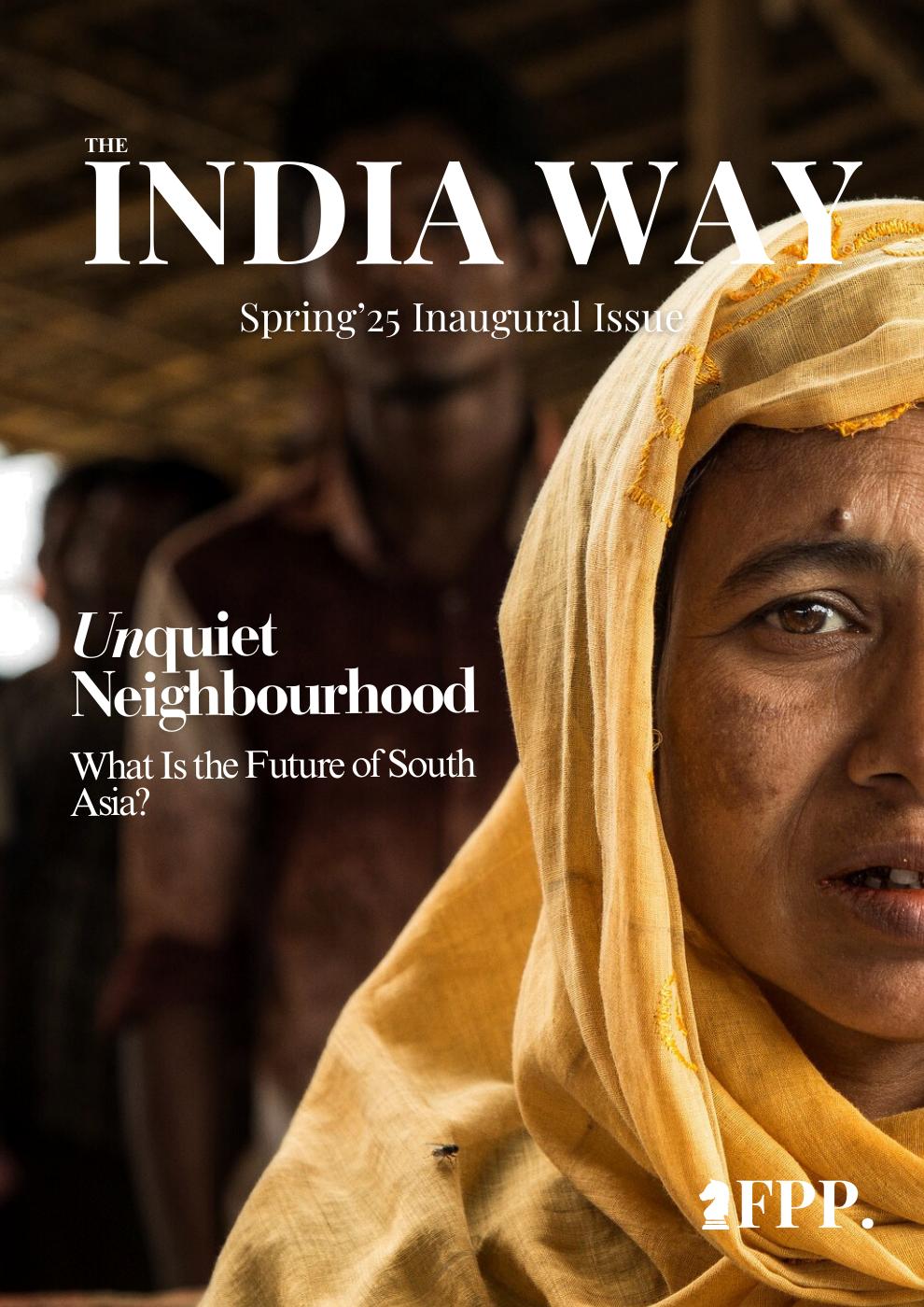
In South Asia, history doesn't just echo, it reverberates. Our pasts are heavy, our presents turbulent, and our futures uncertain. Yet, amidst rising hate, political volatility, economic hardship, and strategic rivalries, the region's youth refuse to be mere bystanders. We are not waiting to inherit the future, we are already building it.
South Asia is one of the youngest regions in the world, home to over 800 million people under 30. That's not a demographic fact, it's a tidal force of possibility. We, the youth, are the region's strongest asset and its most underused resource. At this very moment, in tea stalls and tech hubs, universities and refugee camps, climate marches and call centres, young South Asians are debating, dreaming, resisting, and reimagining. But we do so while carrying the weight of contradiction. We are more educated and connected than ever, yet face some of the world's highest unemployment rates. We are increasingly aware of our shared South Asian identity, yet we also witness growing nationalistic divisions. We are navigating a region rich in diversity, but one where violence in the name of religion, ethnicity, caste, and language is rising. Still, the question we must keep asking and answering is this: what future are we willing to fight for?
 |
| Illustration by Ajitesh Vishwanath |
Young, Restless, and Awake
We are the generation raised on both broadband and border tensions. We've seen our parents survive wars, migration, and structural poverty. We have also grown up watching K-dramas, reading Urdu poetry online, bingeing on Bollywood, and sharing memes across languages. For us, South Asia isn't an abstract geopolitical term. It's home, messy, plural, flawed, and beloved.
This generation isn't apolitical; it's differently political. From India's Shaheen Bagh and Bharat Jodo Yatra to Pakistan's Aurat March, from Bangladesh's Shahbagh movement to Sri Lanka's Aragalaya protests, young people have been at the frontlines of democratic expression. In Nepal and Bhutan, youth are reshaping debates around climate and migration. We're not "apathetic." We're exhausted from being unheard. Our activism is multilingual, intersectional, and deeply personal.
A queer activist in Dhaka finds solidarity with Dalit feminists in India. A young Kashmiri photojournalist and a Sri Lankan artist grieving after the Easter bombings may never meet, but they understand each other's pain. These are not just isolated stories; they are clues to a broader, regional awakening.
The Weight of Identity in a Polarised Age
To grow up South Asian is to grow up negotiating identity daily. We're taught to believe in diversity, yet forced into binaries: Hindu or Muslim, Tamil or Sinhalese, tribal or mainstream, privileged or "other." These divisions are weaponised by politicians seeking short-term wins through long-term damage. And yet, the youth are pushing back.
Social media platforms, while often complicit in spreading hate, have also enabled unprecedented cross-border solidarity. Movements like #DalitLivesMatter, #SaveSilger, or #JusticeForNoor in Pakistan reflect youth-powered demands for accountability and justice. We are telling our own stories, refusing to be defined by colonial categories or nationalist rhetoric.
Still, this resistance comes at a cost. Surveillance, censorship, and online trolling are everyday realities for outspoken youth. Journalists are jailed, student leaders threatened, and content creators doxed. But repression breeds resilience. If one voice is silenced, five more rise to speak.
Economic Anxiety, Entrepreneurial Energy
Our generation is graduating into uncertainty. In India alone, more than 42% of graduates under 25 are unemployed. In Sri Lanka, the economic crisis has emptied pockets and fridges. Many in Afghanistan are unsure if school will open the next day or if it's even safe to go. Youth in rural Nepal or Balochistan often have two choices: migrate or stagnate.
But adversity has sparked innovation. The informal economy, though often underappreciated, is teeming with young entrepreneurs. From Instagram thrift stores in Dhaka to organic farming collectives in Kerala, young people are finding ways to generate income and impact. Social enterprises like Eco Femme in Tamil Nadu or Saathi Pads in Nepal are not just providing livelihoods, they're solving real, local problems.
And yet, these innovations often go unnoticed by governments still obsessed with top-down "development." If we want a future-ready South Asia, we must invest in youth-led ideas, not just infrastructure. We need education systems that teach critical thinking, not just coding. We need mentorship, not just metrics.
Geopolitics Without the People? Not Anymore
South Asia is increasingly caught in the gravitational pull of larger powers. India and China's tensions spill into border clashes. The U.S. Indo-Pacific strategy sees the region as a pawn in a larger chessboard. Afghanistan is caught in the world's humanitarian blind spot. Pakistan and India remain locked in a loop of suspicion. Meanwhile, climate change looms as an existential threat.
But in all this, where is the voice of the youth? Why are we rarely consulted in matters that will shape our futures? The answer isn't to romanticise youth, but to recognise our relevance. Young South Asians are launching podcasts that decode foreign policy in simple terms. They're organising Model UNs, publishing zines on peace, and creating YouTube channels that question the status quo. Imagine what could happen if states began to see us not as potential risks, but as regional connectors.
What SAARC failed to do, youth-led exchanges might still achieve. Despite political borders, we remain culturally entangled in food, film, literature, and love. We are not naïve about statecraft. But we believe diplomacy must also be emotional, and people-to-people connections can lay the groundwork for political healing.
Rising Hate, Rising Humanity
Hate is profitable politically and algorithmically. It travels fast, especially on social media. But so does kindness. Across the region, youth are telling stories of love across religious lines, of inter-caste friendships, of choosing compassion over conformity.
In India, campaigns like Karwan-e-Mohabbat document stories of everyday harmony amidst mob lynchings. In Pakistan, youth-led initiatives are translating Indian literature into Urdu and vice versa, refusing the idea that language must divide. In Bangladesh, Rohingya youth in refugee camps are creating art and theatre to assert their identity. In the Maldives, young women are forming reading circles to challenge patriarchy and state repression.
These are not just stories; they are strategies for survival. As borders harden, young South Asians are finding soft ways to resist: humour, music, fiction, friendship. We are not dismissing the dangers; we live with them. But we are not giving up either. The future must have more to offer than sectarianism and silence.
A Climate Crisis Without Borders
If there is one issue that demands immediate cross-border cooperation, it's climate change. South Asia is already facing some of the world's worst impacts: floods in Pakistan, droughts in India, glacial melt in Nepal, and rising sea levels in the Maldives. These aren't distant scenarios; they are unfolding now.
Young people are on the frontlines. In India, climate activists like Disha Ravi face arrest for tweeting about farmers' protests. In Pakistan, youth are volunteering for flood relief and tree plantation drives. In Bhutan, conservation is part of the national curriculum. But we need more than piecemeal efforts; we need a regional green vision.
Why aren't we building a South Asian Youth Climate Corps? Why can't we have joint university programs on sustainable development? Why aren't our governments listening to the generation that will face the worst of the damage? This climate crisis could break us or bring us together.
Conclusion: Not Utopia, But Unity
The future of South Asia isn't a monologue written in Delhi or Islamabad. It's a conversation across Colombo, Dhaka, Kathmandu, Kabul, Male, Thimphu. It's being typed right now in WhatsApp groups, scribbled in notebooks, shouted in protests, whispered in safe queer spaces.
We, the youth, are not naïve optimists but fierce realists. We know progress won't come easily. But if we don't speak, others will — and we're tired of being spoken over.
Our region doesn't lack vision. It lacks listening. If truly heard, we can transform not just our countries but South Asia into one rooted in justice, empathy, and courage. This isn't a call for utopia, but for unity — not in sameness, but in shared struggle and hope. Let the world say what it will. We know who we are, and more importantly, who we're becoming.
About the Author: Srijani Ganguly
She has completed her Post-Graduation in International Relations from Jadavpur University, with a strong academic focus on human rights, migration and refugee studies, border security diplomacy, and maritime security. Her academic journey is enriched by a diverse blend of both scholarly and non-academic engagements, reflected through her coursework, internships, and publications. With over three years of experience in the non-profit sector, Srijani previously worked at Responsible Charity, Kolkata, eradicating poverty and fostering the quality growth of 24 underprivileged students.
Read Unquiet Neighbourhood: What is the Future of South Asia