Today, South Asia is something more than the old narratives of territorial disputes, military clashes, or traditional geopolitical calculus. South Asia has become a battlefield of narratives, emotions, aesthetics, and other non-coercive power that goes beyond the state. The internal asymmetries are sharpening; external alignments are shifting; thus, soft power diplomacy has recently taken on a deeper meaning for statecraft beyond simply being an appendage of foreign policy. Soft power diplomacy is a serious matter with real consequences, impacting interstate relations, creating public opinion, and reflecting strategic intent. This paper will explore the changing architecture of soft power in South Asia, conceptually framing it not simply as a diplomatic mechanism but as a site of ideological struggle, symbolic capital, and emotional connectivity.
India's soft power is a prime example of how culture becomes strategy. Whether it is the worldwide spread of Bollywood, like the Ramayana circuit with Nepal, India's employment of cultural artifacts in order to project a civilizational identity has known no limits. Yoga, formerly the spiritual practice of an individual, is now a global diplomatic signature; Indian education aid is used as an epistemic bridge to create long-term ideological affinity. However, the cultural component is not free of strategy. Each artefact is a careful narrative about India's being a benevolent regional leader, a cultural superpower built upon a pearl of ancient wisdom, but still modern in its value. But the tools ascribed to this proved to be both attractive and alienating. The global dominance of Bollywood, or the Hindu civilizational frame, could inadvertently alienate minority narratives or create cultural anxiety for smaller South Asian nations. Cultural artefacts of soft power are never neutral; they come with politics, identity, and power.
Pakistan's soft power diplomacy, at the same time, identifies an alternative current that is equally effective but differently structured. Through its popular television dramas, Sufi musical traditions, and harmonious Islamic solidarities, Pakistan is engaging in a cultural diplomacy that is grounded upon an ethos of emotional resonance and ideological nearness. Its television product, which has residual vast underground audiences in India, not only displays cultural sophistication but intricately weaves together admiration and resistance. Therefore, Pakistan is using its soft power tools to not only woo but, more subtly, battle India's discursive dominance of the region. In doing so, soft power is a field of paradox, as admiration flows despite antagonism, and emotional intimacy continues despite geopolitical hostility. This paradox often comes to the surface with cricket diplomacy and music exchanges, as they often become battlefields instead of bridges.
Most importantly, it would be limiting to consider soft power in South Asia only in terms of a rivalry between India and Pakistan. Smaller states in the region have displayed a remarkable ability to develop their own soft power strategies, even in ways that deviate from mainstream hegemonic soft power schemes. The differing political landscapes of Sri Lanka and Tamil Nadu provide an example of the manner in which cultural continuums can transcend political boundaries based on language and religion. Bhutan has achieved a distinct foreign policy identity based on its Buddhist identity and spiritual symbolism that sets it apart while engaging in cooperative diplomacy. The Maldives has created a flexible soft power position drawing from its Islamic background, its tourism diplomacy, and its regional balancing of India and China. As a conflict-ridden state, Afghanistan has drawn on poetic traditions, civilizational memory, and cultural diplomacy to navigate its own strategic relevance. These states do not simply accept the soft power of larger states; they negotiate, resist, and redirect soft power to best match their priorities and insecurities.
In post-colonial South Asia, soft power is functioning as a mechanism of cultural self-reclamation. For states grappling with colonial legacies, the projection of their culture, values, and identity outside of their borders can represent a way of asserting epistemic sovereignty. Additionally, soft power represents more than a benign influence; it represents an act of rewriting the self in the global imagination. While Buddhist diplomacy, literary festivals, craft traditions, and performance cultures might seem like separate acts of cultural projection, they all present a counter-narrative to historical subordination. Hence, soft power functions as much as a symbolic act of resistance as it does as a strategic undertaking.
Then, the role of South Asian diasporas — from the Gulf to North America — can extend these symbolic flows even further. Diaspora communities are transnational agents, carrying their languages, festivals, cinematic worlds, and recipes beyond the homeland and into global spaces. These cultural memories reinforce how states are understood and perceived abroad. Crucially, diasporas are not passive, uncreative inheritors of cultural heritage but active agents in the global mediation of South Asian soft power.
Cricket is perhaps the dominant form of cultural expression in South Asia, where players become demigods, and stadiums become temples of emotion, both sites of connectivity and contest. Matches, their outcomes, often expressed with unheard forms of reproduction and fist-pumping, especially between India and Pakistan, transcend sport and aptly mirror the volatility of diplomatic relations between nations. Heroes like Sachin Tendulkar (the living embodiment of national aspiration), Mahendra Singh Dhoni (the most calm and strategic mind from suburban Ranchi who led India to global glory), Virat Kohli (the fiery and ostensibly disciplined shape of modern Indian confidence), have moulded public imagination and narrative across the borders of South Asia. Despite geopolitical antagonism, on occasion, Pakistani fans will admire Kohli's fighting spirit, just as Indians have stoked nostalgia by cheering for Wasim Akram's artistry. Cricket, therefore, orderly fuses the polarities of admiration and rivalry, memory and nationalism, emotion and strategy. On a subcontinent marked by fissures of history, cricket remains a highly symbolic and performative field of soft power, where contests are cultural, where heroes go further, and where each radiates farther than politics allows goodwill.
South Asian food is a deeply underrated but effective form of soft power — especially in the diaspora context. Dishes such as biryani, momo, butter chicken, machher jhol and masala dosa are so popular in global dining culture that their stories, spices, and symbols of home are also transported along with them. Culinary diplomacy is not limited to food festivals or banquets but includes the everyday practice of cultural assertion by the diaspora. Food connects nostalgia and identity, allowing even fraught areas to engage through flavour. India and Pakistan might disagree politically, but they share a similar culinary inheritance that is easily accessible across cultures and borders.
As institutional regionalism weakens, particularly with the dormancy of SAARC, soft power diplomacy fills the void left by formal mechanisms. It is through festivals, pilgrimages, media flows, and symbolic leadership that South Asia now imagines itself. The region is not only bound by strategic compulsions but also by shared stories, contested memories, and emotional allegiances. What looks like mere cultural expression is, in fact, a performance of power, legitimacy, and belonging. This is not the soft background score of diplomacy; it is the main act. Soft power today is not supplementary to geopolitics in South Asia; it is the grammar through which geopolitics is increasingly being written.
Connectivity, both infrastructural and ideational, is critical for how soft power circulates and transforms throughout the region. Civilizational links like shared Buddhist civilizational heritage or mutual linguistic relations can often serve as conduits for soft power flows. Religious diplomacy is very strong in this space: the Pakistan-Bangladesh Islamic link, the India-Nepal Ramayana circuit, and cross-border pilgrimage are not just sites of spiritual engagement but of geopolitical engagement. Even cricket, arguably the most widely shared cultural pastime in South Asia, is a space of fierce nationalism and symbolic competition, showing that when soft power is played out in and through shared fervour, it is not soft!
Theoretically, this essay engages Joseph Nye's initial framing of soft power as a force of attractiveness and persuasion and then re-reads it with Pierre Bourdieu's notion of symbolic capital — the capacity to legitimise particular forms of cultural expression as valid or superior. In South Asia, soft power is not on the periphery or a decorative component because it is rather important in the way it constructs the hierarchies of the regional space. With the loss of institutionalised regionalism, by way of the passive functionality of SAARC, soft power has effectively stepped in to fill the gap that formal diplomacy has left behind. What exists now is not a deficit of regionalism, but rather a reconfigured regionalism — one that is fluid, affective, and discursively governed by symbols instead of structures.
There are rich examples from South Asia in terms of how countries have different ways of using soft power. Consider Bhutan's Gelephu Mindfulness City, which merges spirituality and sustainability in an impressive way. Pakistan has the much-loved Coke Studio, where classical music and contemporary music come together to develop its global image. Sri Lanka has utilised its Theravada Buddhist heritage to create religious and cultural links with Southeast Asia and India. India has continually demonstrated the effects of its civilizational weight through Bollywood, yoga, and education. Nepal pursues a project of mythological diplomacy with the Ramayana circuit. Bangladesh continues the work of post-colonial creativity and leadership through the Dhaka Lit Fest and also its textile art culture. The Maldives uniquely reconciles an Islamic identity with high-value tourism to navigate strategic partnerships, while Afghanistan, through its significantly durable poetic and artistic heritage, including the cultural memory of the Bamiyan Buddhas, is able to assert its soft power despite ongoing political instability.
In summary, soft power diplomacy in South Asia is not a soft undertow; it is a very strong, strategic, and contested power with multifaceted functions such as leadership, legitimacy, resistive power, and renown. It does work through attraction, indeed, but it also works through exclusion. It unites but divides. It creates ties that are deeply civilizational but also rekindles memories that are agonistically political. The region is not bound exclusively by geography any longer, but also by its stories and self-identities. In this developing geopolitical order, soft power is not an addition to strategy — it is strategy.
About the Authors: Astha Panda & Dr. Malini Prava Sethi
ASTHA PANDA is a second-year postgraduate student at the Centre for South Asian Studies, Pondicherry University. Concurrently, she is also working as a research consultant at the National Institute of Advanced Studies, Bangalore. Her research interests include soft power diplomacy, cultural diplomacy, media analysis, non traditional security issues, and perspective studies with a special focus on South Asia and Southeast Asia.
DR. MALINI PRAVA SETHI is an Assistant Professor in the Department of Geography at Ravenshaw University, Cuttack, Odisha. She holds a Ph.D in International Relations from Jawaharlal Nehru University, New Delhi. She is a passionate researcher, and her research interests are centred on sustainable community livelihoods and resilience. Her areas of specialisation include Geopolitics, disaster management, tourism studies, environment and sustainable development.
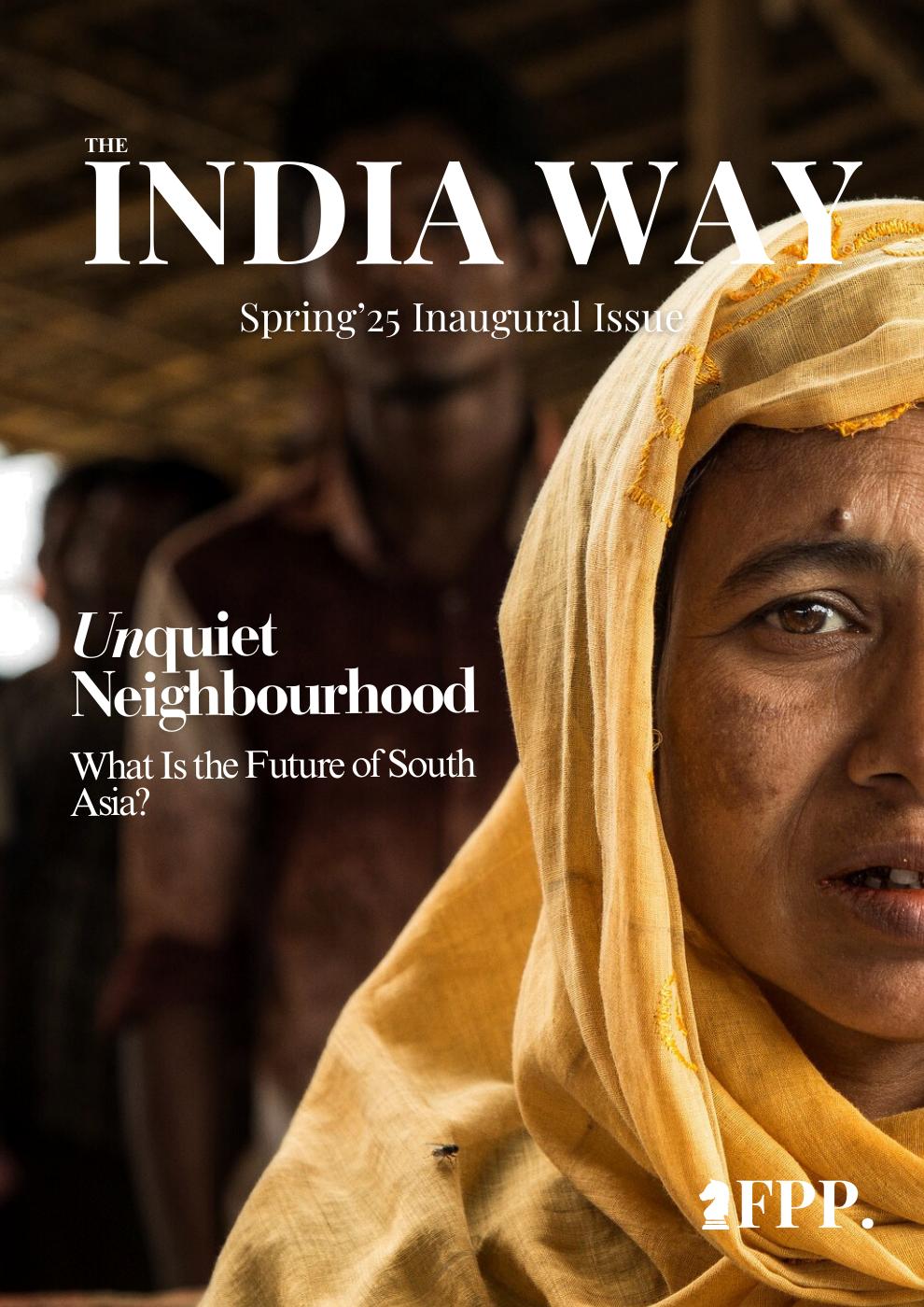
Read Unquiet Neighbourhood: What is the Future of South Asia